
Loading dashboard
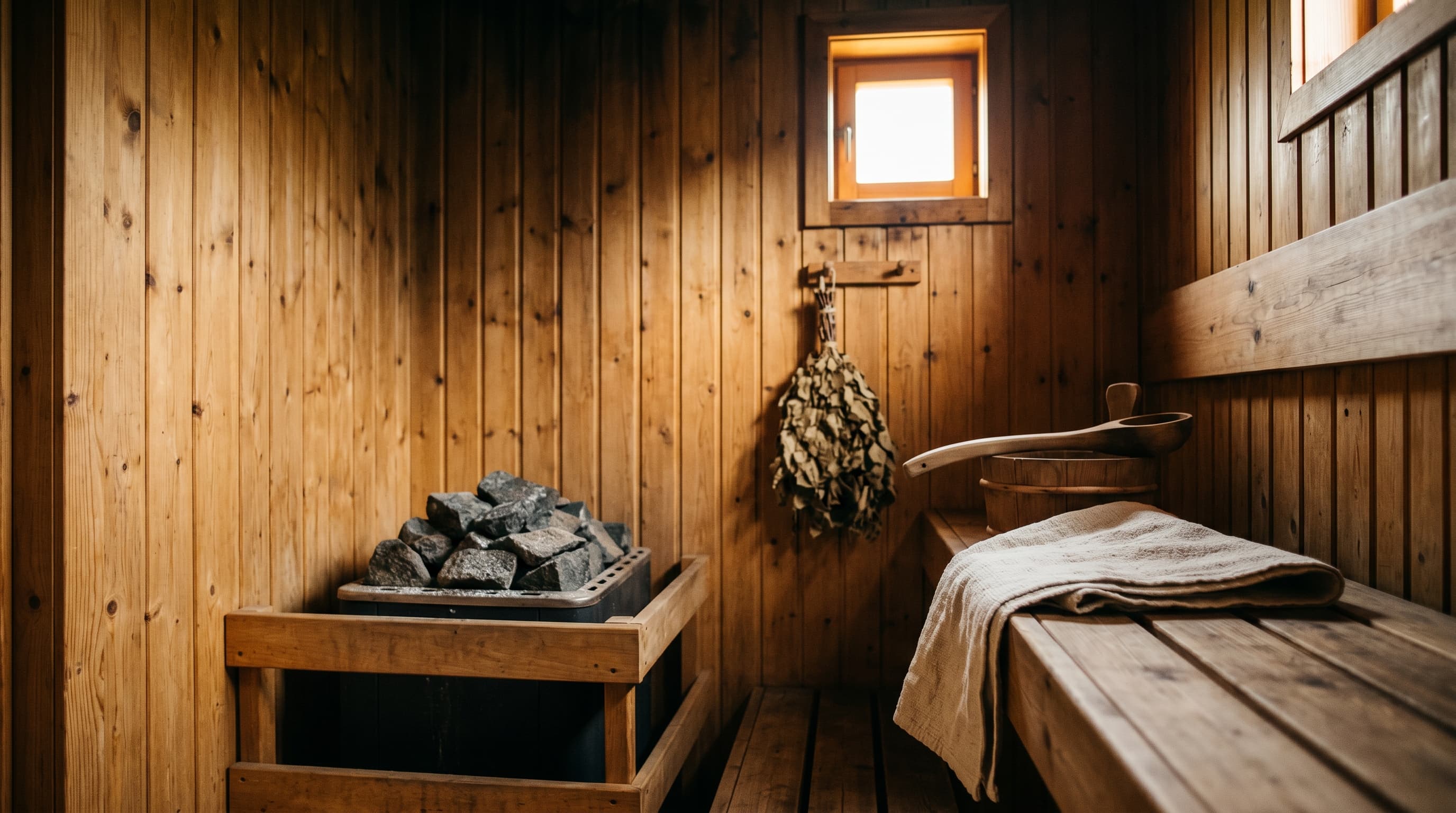
Traditional dry sauna at steady, tolerable heat, where the body opens blood vessels near the skin and the heart pumps harder to move heat out while defending core temperature.
The practical support is strongest for tracking resting heart rate, optional morning blood pressure, session tolerance, symptoms, and context over repeated dry-sauna sessions, not for expecting a uniform improvement.
Best read as a bounded dry-sauna self-experiment for tolerability, recovery context, and short-horizon cardiovascular proxies, not as proof of long-term disease prevention or a guarantee that HRV, vascular, immune, toxin, fertility, or sleep-stage markers will improve.
The extracted evidence is heterogeneous, several adjacent intervention endpoints are mixed or null, major cohort findings are context only, and external high-heat routines should stay separate from the Murph canonical protocol.
Sources checked is every card shown on this page. Direct human participants counts only primary human studies with coded participant totals, deduplicated by cohort when possible. Review cards may show larger pooled head counts on their own rows, and those pooled totals are treated as approximate rather than added into the page-level number.
Reviews set the overall direction: sauna is physiologically active and plausible, but the evidence is mixed enough that claims should stay modest.
23 sources · 23 reviews
Passive-heating RCT meta-analysis found mostly null or mixed non-acute cardiometabolic results.
Direct dry-sauna systematic review supports cautious protocol rationale but highlights heterogeneity.
Finnish-sauna review supports mechanism-rich but evidence-calibrated protocol framing.
Recent passive-heat review favors Finnish sauna as the strongest sauna-adjacent evidence base.
This narrative review synthesizes cardiovascular, inflammatory, and mortality evidence for sauna bathing. The main finding is a coherent mechanism-and-outcomes story, especially around cardiovascular stress, vascular function, and long-term associations.
This safety review summarizes older evidence on sauna physiology, benefits, and adverse contexts. The main finding is that sauna exposure affects circulation, thermoregulation, and symptoms enough to require risk screening.
This clinical review summarizes potential sauna benefits, risks, and contraindications. The main finding is balanced: sauna may be well tolerated for many people, but risk rises with certain medical conditions, dehydration, alcohol, or medication contexts.
Healthspan review is useful context but not a direct protocol claim source.
Narrative review frames sauna evidence as mainly observational with safety considerations.
This narrative review separates common sauna claims from better-supported physiology and safety observations. The main finding is that sauna has plausible benefits and real risks, but many popular claims need careful framing.
This narrative review compares health effects of heat and cold with special attention to Finnish sauna bathing. The main finding is that heat and cold exposures should be treated as separate physiological stressors with different mechanisms and risks.
Small blood-pressure meta-analysis found a BP-lowering signal with heterogeneous trials.
This narrative review synthesizes classic Finnish sauna physiology, risks, and practical claims. The main finding is a broad context map: sauna produces meaningful heat stress, cardiovascular, thermal, fluid, and endocrine responses, but the evidence is mixed by outcome.
This cardiovascular-disease review reinforces that sauna is a real circulatory stressor whose benefits and risks depend on baseline health status, medication context, and supervision.
This cardiovascular-disease review reinforces that sauna can be tolerable in selected clinical settings, but only with explicit population and supervision caveats.
This endocrine review reinforces that sauna is a real systemic stressor, which supports mechanism plausibility without turning hormone changes into promised consumer outcomes.
This ventilation review keeps the evidence backbone grounded in real sauna respiratory physiology rather than generic wellness language.
Sudden-cardiac-death review supports cardiovascular plausibility without proving a personal protocol effect.
High-stress-occupation review gives cardiometabolic mechanism context.
Lifestyle-factor review frames sauna as one part of a broader health pattern.
Rheumatic-disease review gives condition-specific symptom and caution context.
Ischemic-heart-disease review supports cardiovascular plausibility with clinical caveats.
Cardiovascular/PAD review frames sauna as plausible but clinically bounded.
Older thermoregulation work explains the heat strain, sweating, heart-rate load, and cooldown needs behind the protocol.
1 source · 1 review
Direct Finnish sauna thermoregulation context defines acute heat strain.
Acute and repeated-session studies make pulse, blood pressure, HRV, sleep context, symptoms, and training context worth watching, without promising a uniform response.
38 sources · 20 physiology studies · 10 reviews · 4 trials
Six-week 3x/week dry sauna improved HRV-frequency and respiratory measures in allergic-rhinitis patients.
This acute study measured cardiovascular function before and after a single sauna session in adults with cardiovascular risk factors. The main finding is that sauna can acutely change blood pressure, heart rate, arterial stiffness, and related markers.
Standalone sauna and exercise-plus-sauna produced different acute cardiovascular responses.
Acute Finnish sauna shifted immune-cell counts more clearly than cytokines.
This acute physiology study compared sauna blood-pressure and heart-rate responses with submaximal dynamic exercise. The main finding is that a sauna bath can create cardiovascular responses comparable to light-to-moderate exercise stress.
Acute sauna recovery favored cardiac autonomic markers in a 93-participant study.
Mixed heat therapy meta-analysis shows blood-pressure and vascular-function signals.
RCT-only passive heating synthesis finds mostly null cardiometabolic outcomes with cautious systolic BP signals.
Heat thermotherapy meta-analysis shows modest DBP reduction but mixed cardiometabolic markers.
Single Finnish sauna session acutely changed white-blood-cell profile and fluid-related measures.
Brief Finnish-sauna exposure did not acutely improve FMD or reactive hyperemia in healthy adults.
High-temperature repeated-bout sauna acutely lowered blood pressure and changed body mass/biochemistry in prepared young men.
This acute Finnish-sauna study measured haemodynamic and hormonal responses in healthy adults. The main finding is that a sauna bath creates measurable cardiovascular and hormonal stress, even in healthy volunteers.
Passive-heating autonomic review supports HRV plausibility but not a guaranteed signal.
Classic circulation review explains acute sauna physiology.
This companion physiology study measured circulation during sauna, shower, and ice-water exposure. The main finding is that hot and cold exposures can rapidly shift cardiovascular load and circulation.
Classic endocrine review frames sauna as a controlled physiological stressor.
High-stress occupation review supplies mechanism hypotheses with population mismatch.
ESH HBPM position paper anchors the protocol’s morning BP measurement method.
AHA BP statement supplies measurement rules for interpreting morning BP.
This companion physiology study measured body-temperature responses across sauna, shower, and ice-water exposure. The main finding is that heat and cold sequencing changes thermal load, not just subjective comfort.
ESH guideline supports standardized office and out-of-office BP measurement.
HOPE Asia guidance adds regionally relevant morning-BP measurement context.
Current HBPM review updates home BP implementation context.
Acute intense sauna raised prolactin and norepinephrine in a small women-only study.
Stable-CAD acute study found vascular benefits in a clinical Finnish-sauna context.
This repeated-exposure physiology study followed healthy volunteers through seven days of sauna bathing. The main finding is that repeated sauna produces cardiovascular and metabolic responses that matter for blood pressure, heart rate, and tolerance framing.
This acute study compared Finnish sauna with other heat-bath procedures in healthy volunteers. The main finding is that Finnish sauna is one distinct heat stressor among several, with systemic responses that differ by modality.
Single versus repeated Finnish-sauna sessions showed different immune/HSP-70 responses.
Warm bath/shower passive heating improves sleep outcomes in adjacent evidence.
Finnish-sauna crossover work measured inflammatory markers around acute exposures.
Heat therapy review supports cardiovascular mechanistic plausibility.
This clinical sauna-plus-cold physiology study supports blood-pressure, heart-rate, and autonomic context while showing why cold-immersion sequences should stay separate from the default sauna test.
Repeated sauna exposures changed oxidative and nitric-oxide context in training and non-training men.
Post-exercise Finnish sauna changed oxidative-status context in healthy men.
This repeated-exposure endocrine study supports sauna as a real short-horizon stress-and-recovery signal, while keeping hormonal changes separate from promised consumer outcomes.
Classic thermoregulation review explains sweating, heart-rate strain, and cooling needs.
Sauna/cold/rest totonou study adds exploratory neural and subjective-state context.
Intervention studies show useful signals alongside null or mixed results, especially when sauna is combined with exercise or clinical care.
29 sources · 18 trials · 8 reviews · 1 physiology study
Modern multi-arm RCT found regular post-exercise sauna did not improve HRV.
This heat-acclimation pilot studied repeated post-exercise sauna exposure in well-trained cyclists. The main finding is that adaptation may build across repeated sessions, with plasma-volume, HRV, and performance context.
Eight-week Finnish-sauna CAD RCT did not clearly move vascular-health markers.
Four weeks of post-exercise sauna did not improve targeted gut or hsCRP outcomes.
This single-arm study tested repeated sauna bathing in young physically active men and lipid markers. The main finding is that lipid and cardiometabolic markers were explored over repeated sessions, but without a strong control design.
Passive heat therapy in CVD shows clinical-marker signals under mixed supervised protocols.
Passive heating can produce acclimation signals in athlete-focused protocols.
Sauna-treatment meta-analysis reports positive cardiovascular signals but is adjacent to the protocol.
Exercise-plus-sauna RCT moved cardiovascular outcomes but blends two interventions.
This randomized study tested regular sauna bathing for chronic tension-type headache. The main finding is that symptom outcomes can be studied with repeated sauna exposure, but the endpoint is condition-specific.
This controlled trial followed adults for common-cold incidence over six months. The main finding is that regular sauna bathing was tested as a respiratory-illness intervention, but it is not a direct wearable recovery signal.
Hematological Adaptations to Post-Exercise Sauna Bathing With No Fluid Intake: A Randomized Cross-Over Study — safety-only appraisal
Extreme-heat sauna plus resistance training is a co-intervention boundary source.
Supervised low-temperature Waon therapy improved exercise-related outcomes in severe COPD.
Hot-water immersion changes acute cardiovascular markers but long-term benefits are inconclusive.
Exercise heat acclimation review identifies adaptation mechanisms relevant to heat stress.
Three-week post-exercise sauna improved exercise-capacity markers in trained runners.
Post-exercise sauna may be practical in athlete heat-acclimation contexts.
Exercise-plus-sauna arterial-compliance article suggests positive acute hemodynamic direction, with limited extraction.
Athlete heat-alleviation guidance supplies general heat-management context.
Clinical PAD heat therapy has modality-specific mixed findings.
Repeated sauna exposure drove heat-acclimation style responses in elite skiers.
Type 2 diabetes heat-therapy meta-analysis suggests possible slight cardiometabolic benefit.
Exercise load before sauna changed acute neuromuscular and hormonal responses.
This supervised heart-failure pilot shows repeated sauna can be feasible and physiologically meaningful in a clinical setting, while staying far from a generic home claim.
This supervised heart-failure pilot keeps intervention expectations grounded: sauna can be tolerable and physiologically active in a clinical setting without becoming a general home claim.
Post-exercise sauna recovery should be judged partly by next-session performance.
Runner sauna adaptation study found sex-specific interpretation matters.
HFpEF pilot used ramped supervised sauna over 10 weeks and reported functional context.
Athlete and recovery studies should be logged separately from stand-alone sauna because workout timing can change both benefit and risk signals.
2 sources · 2 reviews
Post-exercise heat exposure does not clearly improve endurance performance beyond training.
Post-exercise heat exposure has mixed recovery and performance-adaptation evidence.
Practice guides define ordinary session behavior, beginner pacing, hydration, breaks, and exit-if-unwell rules; they are not efficacy evidence.
4 sources · 3 guidance sources · 1 review
Saunologia gives practical Finnish-sauna sequence and beginner stop-rule guidance.
InfoFinland gives practical Finnish-sauna parameters and basic safety rules.
Finnish Sauna Society provides official practice instructions for sauna bathing.
Finnish Sauna Society summarizes circulation, sweating, relaxation, and cold-swim safety context.
Design and FAQ sources help set practical boundaries for temperature, humidity, ventilation, frequency, and home or community sauna use.
2 sources · 2 guidance sources
North American Sauna Society build guidance gives temperature and construction safety guardrails.
North American Sauna Society FAQ supports wet/dry humidity context and typical 2–3x/week use.
Modality sources keep traditional Finnish sauna separate from steam rooms, infrared sauna, hot-water immersion, and contrast routines.
1 source · 1 guidance source
Sauna Society distinguishes traditional Finnish sauna humidity control from very-low-humidity dry sauna.
Finnish cohort and real-world studies give long-horizon context, but they should not be read as proof that a short self-experiment will prevent disease.
21 sources · 20 observational studies · 1 review
This prospective KIHD cohort paper linked sauna frequency with fatal cardiovascular and all-cause mortality over long follow-up. The main finding is an inverse long-term association, not proof that a short experiment will move wearable metrics.
This prospective cohort study extended sauna-mortality analysis to Finnish men and women. The main finding is that sauna exposure was associated with lower cardiovascular mortality and improved risk prediction in that cohort.
This prospective cohort study linked sauna bathing frequency with incident hypertension risk. The main finding is directly relevant to blood-pressure rationale, but it is still observational and long-term.
Sauna-plus-lifestyle review protects against over-attributing cohort signals to sauna alone.
Correct PubMed record for the Finnish prospective stroke cohort; used as long-term context, not as a short-term protocol endpoint.
This prospective KIHD cohort paper examined sauna bathing together with cardiorespiratory fitness. The main finding is that sauna and fitness may have joint associations with lower cardiovascular and all-cause mortality risk.
This prospective KIHD biomarker paper links sauna frequency with inflammation and oxidative-stress markers over time. The main finding is a mechanistic bridge between long-term cohort outcomes and measurable biology.
Sauna bathing, renal function and chronic kidney disease: Cross-sectional and longitudinal findings from the KIHD study — context-only appraisal
Prospective Finnish male cohort found no clear cancer-risk increase or decrease by sauna frequency.
This prospective KIHD cohort paper associated frequent sauna bathing with lower pneumonia risk over long follow-up. The main finding is a respiratory long-horizon signal, not an immediate experiment outcome.
This prospective KIHD cohort paper associated frequent sauna bathing with lower respiratory-disease risk. The main finding is an observational long-term respiratory signal that may fit education and rationale.
This prospective KIHD cohort paper associated sauna frequency with lower dementia and Alzheimer's disease risk in middle-aged Finnish men. The main finding is a long-term brain-health association, not a near-term cognition experiment result.
This prospective KIHD cohort paper linked sauna frequency with risk of psychotic disorders over long follow-up. The main finding is a neuro-mental observational signal, not a short-term mood or cognition result.
This prospective KIHD cohort paper associated sauna bathing with lower venous thromboembolism risk. The main finding is an observational vascular outcome beyond classic cardiovascular endpoints.
KIHD socioeconomic-status analysis shows sauna associations depend on broader baseline context.
Inflammation and sauna cohort analysis adds mechanistic context to long-run associations.
KIHD mortality analysis suggests baseline systolic blood pressure may modify sauna associations.
KIHD fitness analysis links sauna patterns with cardiorespiratory-fitness context.
This Finnish child-survey paper adds real-world sauna-use and symptom context, but it belongs in age-specific background rather than the adult outcome promise.
Northern Sweden MONICA study adds real-world sauna-use context.
Women sauna-user survey adds subjective well-being and real-world-use context.
Safety and special-population sources set the strongest rules: screen risk, keep dose conservative, hydrate, avoid alcohol and unsafe medications, and stop early when symptoms appear.
69 sources · 25 physiology studies · 21 reviews · 11 trials
Fimea issues a warning: Wearing an opioid patch in the sauna may cause life-threatening poisoning — safety-only appraisal
Can I use a sauna or hot tub early in pregnancy? — safety-only appraisal
Death in Sauna Associated With a Transdermal Fentanyl Patch — safety-only appraisal
Heat and Medications – Guidance for Clinicians — safety-only appraisal
Clinical Overview of Heat and Pregnancy — safety-only appraisal
The effect of prescription and over-the-counter medications on core temperature in adults during heat stress: a systematic review and meta-analysis — safety-only appraisal
Maternal hyperthermia and the risk for neural tube defects in offspring: systematic review and meta-analysis — safety-only appraisal
Maternal heat exposure and neural tube defects — safety-only appraisal
This review focuses on Finnish sauna use in people with cardiovascular disease. The main finding is that sauna exposure has real cardiovascular effects, so benefits and risks must be interpreted by baseline health status and medication context.
Heat exposure and drugs. A review of the effects of hyperthermia on pharmacokinetics — safety-only appraisal
Physical Activity and Exercise During Pregnancy and the Postpartum Period: ACOG Committee Opinion, Number 804 — safety-only appraisal
Effects of a Finnish sauna on the pharmacokinetics and haemodynamic actions of propranolol and captopril in healthy volunteers — safety-only appraisal
In sporadic female sauna users, 80°C looked tolerable while 120°C created a clear safety boundary.
Heat stress and fetal risk. Environmental limits for exercise and passive heat stress during pregnancy: a systematic review with best evidence synthesis — safety-only appraisal
Seminal and molecular evidence that sauna exposure affects human spermatogenesis — safety-only appraisal
Same source reports fertility-marker worsening without cooling and lists practical contraindications.
Older acute Finnish-sauna experiment documents strong physiological strain and adverse events at 80–90°C.
Benefits and risks of sauna bathing — safety-only appraisal
Sudden-cardiac-death review supports cardiovascular context but keeps uncertainty visible.
Women sauna-plus-cold study shows measurable cardiovascular load.
This review evaluates Finnish sauna use in patients with cardiovascular disease. The main finding is that clinical context determines whether sauna is likely tolerable or risky.
Severe dry and wet sauna exposures produced comparable heat strain after 20 minutes.
Heat/cold review helps keep Finnish sauna distinct from contrast-therapy claims.
Narrative review supports general Finnish-sauna tolerability but emphasizes weak study designs.
This pilot report tested sauna safety, acceptance, and physiologic effects in people with chronic heart failure. The main finding is that supervised sauna was studied as a tolerability and physiology exposure in a clinical population, not a general wellness shortcut.
Dry versus steam comparison shows humidity and modality change physiological strain.
The sauna and body fluid balance — safety-only appraisal
Extreme repeated sauna exposure changed endocrine markers and produced transient amenorrhea in five of seven women.
Heating mode changed cerebral blood-flow response at thermal tolerance.
No-fluid post-exercise sauna study shows hydration can materially change responses.
This pilot intervention tested repeated sauna bathing in chronic systolic heart failure patients. The main finding is that supervised repeated sauna may be feasible and physiologically meaningful in a clinical group, but the evidence is preliminary.
The sauna and pregnancy — safety-only appraisal
Young-women hot/cold thermal-stress study is adjacent, not ordinary dry-sauna evidence.
Suggested limits to the use of the hot tub and sauna by pregnant women — safety-only appraisal
Review-level context frames ordinary sauna as tolerable for healthy and stable cardiovascular populations.
Sauna-Induced Body Mass Loss in Young Sedentary Women and Men — safety-only appraisal
American College of Sports Medicine position stand. Exertional heat illness during training and competition — safety-only appraisal
This acute Finnish-sauna and cold-water study measured hemodynamic and autonomic responses in heart failure, CAD, and control participants. The main finding is that the sauna-plus-cold sequence has measurable cardiovascular effects in clinical and control groups.
Hot-water passive heat therapy improved vascular function and mean arterial pressure, but it was not sauna.
Effects of sauna on sperm movement characteristics of normal men measured by computer-assisted sperm analysis — safety-only appraisal
IHD narrative review adds clinical cardiovascular context only.
Waon heart-failure review is a clinical sibling-variant guardrail.
Cardiovascular effects of atenolol, scopolamine and their combination on healthy men in Finnish sauna baths — safety-only appraisal
CVD/PAD heat-therapy review is adjacent clinical context.
Far-infrared sauna review defines a sibling modality boundary.
Sauna-specific semen-quality harm was not confirmed, but genital heat remains a fertility boundary.
Heat-stress consensus supports gradual acclimatization, hydration, cooling, and emergency planning.
The effect of a single sauna exposure on spermatozoa — safety-only appraisal
This crossover study tested sauna exposure with alcohol in healthy adults. The main finding is that alcohol can change the cardiac, blood-pressure, electrolyte, and cortisol context of sauna bathing.
FIR review supplies terminology for infrared-sauna boundary claims.
Effects of heat exposure in a Finnish sauna on the pharmacokinetics and metabolism of midazolam — safety-only appraisal
The sauna, skin and skin diseases — safety-only appraisal
Regular sauna users showed skin-barrier differences in an exploratory controlled study.
Differential effects of sauna-, diuretic-, and exercise-induced hypohydration — safety-only appraisal
This crossover study tested Finnish sauna exposure under atenolol, scopolamine, and combined drug conditions. The main finding is that medications can change cardiovascular responses to sauna heat.
Repeated 4 × 10-minute dry sauna study adds body-size, fluid, and tolerance context.
This pharmacokinetic crossover study tested whether Finnish sauna heat changed midazolam handling. The main finding is a safety-context result: heat exposure can be relevant when interpreting medication metabolism and tolerance.
This cross-sectional survey describes how Finnish women used sauna during pregnancy. The main finding is not an efficacy claim, but a safety-context record about real-world pregnancy habits and tolerance.
This cross-sectional study describes sauna habits and symptoms in Finnish children. The main finding is observational: sauna use was common enough to study, but symptoms and age context matter.
This sauna-plus-cold circulation study reinforces that rapid thermal switching changes cardiovascular load enough to require explicit cold-exposure guardrails.
This pediatric physiology study measured cardiovascular adjustment during acute sauna exposure. The main finding is that children can show measurable heart-rate and blood-pressure responses to sauna heat.
This sauna-plus-cold body-temperature study reinforces conservative duration, cooldown, and symptom stop rules when mixed thermal exposures are layered together.
This pediatric physiology study examined ECG changes around sauna exposure. The main finding is that acute sauna can interact with cardiac electrical monitoring in children, making safety context important.
Classic loyly paper defines the heat and humidity experience behind Finnish sauna.
This narrative physiology review summarizes how sauna bathing affects endocrine regulation. The main finding is that heat exposure can activate hormonal stress and recovery pathways, with context-dependent effects.
This narrative physiology review covers lung and ventilation responses in the sauna. The main finding is that respiratory effects are part of the sauna response, especially for heat tolerance and symptom context.
This thermal-sequence study measured body-fluid responses to sauna, shower, and ice-water exposure. The main finding is that brief heat and cold sequences can alter fluid balance enough that hydration status matters.
This acute physiology study measured endocrine responses to sauna, shower, and ice-water immersion. The main finding is that heat and cold sequences can activate stress-hormone responses.
Acute 100 °C heat exposure is an aggressive strength-training context.
Facility and public-health guidance covers cleaning, signage, temperature controls, monitoring, and shared-space hazards.
3 sources · 2 guidance sources · 1 review
NCCEH rapid review maps environmental and physiological hazards in sauna settings.
Alberta public-pool standards set operational sauna temperature and monitoring requirements.
WHO guidance provides broad recreational-facility hazard-control context.
Named public routines are useful comparison points, but their self-experiment claims should not become Murph outcome promises.
5 sources · 5 supporting sources
External N-of-1 sauna protocol reports biomarker improvements but with unresolved causality.
Self-review reports persistent vascular, toxin, microplastic, and fertility benefits from the initial protocol.
Huberman Lab external protocol overlaps the target temperature and frequency range.
Blueprint external protocol overlaps Murph temperature/duration but is based on a self-experiment and public guidance.
Podcast episode is an external protocol discussion, not a primary evidence source.
High-heat public routines can inform what to log, but they should not change the default dose or encourage threshold chasing.
1 source · 1 supporting source
Public daily routine reports 20 min at 200°F with heat-protection add-ons.
Core-temperature posts are useful for measurement context, not for turning a 39 C target or heat-shock-protein threshold into a requirement.
2 sources · 2 supporting sources
232-session review says the 20 min protocol missed a claimed core-temperature/HSP threshold.
Ingestible sensor post reports 31 min to reach about 39°C core temperature at 200°F dry sauna.
Reports of painful or panic-level high-heat attempts support clear stop rules and gradual progression.
2 sources · 2 supporting sources
The review cautions against abrupt long sessions at extreme heat.
The high-heat threshold attempt was described as painful and panic-inducing.