
Loading dashboard
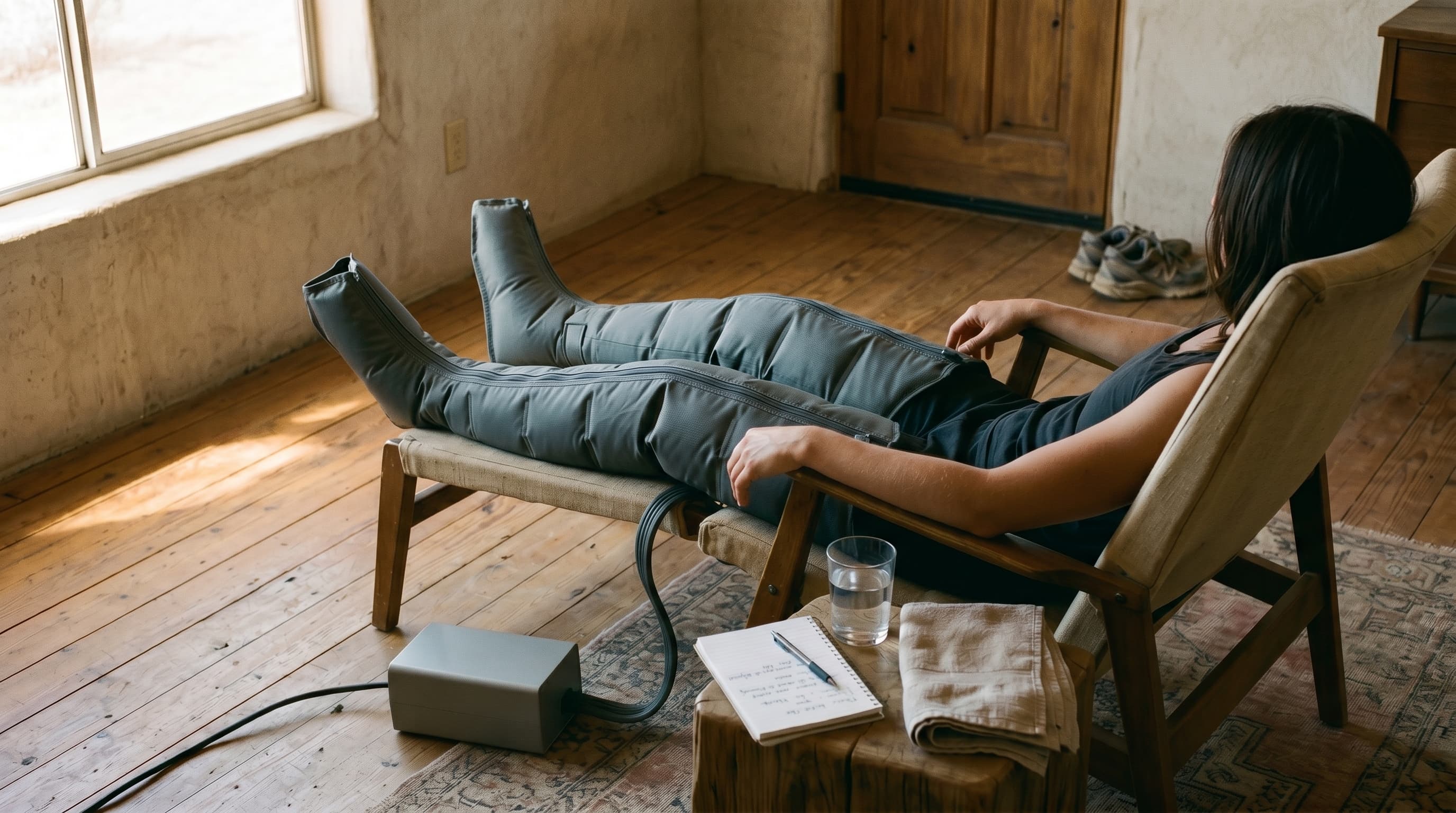
Pneumatic compression pants that rhythmically squeeze the legs, helping move blood and fluids to potentially ease soreness and improve comfort after exercise.
Pneumatic compression pants may reduce perceived soreness, pain, or immediate fatigue for some post-exercise users, but objective recovery, performance, biomarker, and wearable-recovery outcomes remain inconsistent.
Evidence supports a cautious, symptom-first self-experiment for soreness or leg comfort, not a strong efficacy claim for performance, biomarkers, clot prevention, swelling treatment, or disease management.
The safety and clinical-boundary evidence is stronger for page language than the consumer efficacy evidence: screen first, stop early, and keep medical indications out of this variant.
Reviews and completed sports-recovery trials most consistently support cautious soreness, pain, immediate-fatigue, or perceived-recovery language while limiting performance, CK/inflammation, lactate, heart-rate-response, and broad recovery claims.
17 sources · 12 trials · 5 reviews
Support only cautious claims: IPC may help perceived soreness/pain, while broader recovery and performance effects remain uncertain.
Pressotherapy may be useful as an add-on recovery practice for soreness, but not as a stand-alone performance recovery intervention.
A practical protocol page should emphasize uncertainty and frame lower-limb IPC as a possible soreness/perceived-recovery tool rather than a proven performance enhancer.
Pneumatic compression pants can be framed as a possible short-term comfort tool, not as proven EIMD treatment for endurance athletes.
The protocol should avoid superiority claims.
Pneumatic compression pants may feel beneficial after intense cycling, but this trial does not support a claim that they improve immediate follow-up cycling power.
A single short IPC session may reduce immediate perceived fatigue after extreme running but should not be presented as restoring running performance.
Do not claim high-pressure IPC restores strength or jump performance after muscle damage; soreness may still be worth tracking.
A 30-minute high-pressure IPC session after soccer match play should not be claimed to improve neuromuscular, biochemical, or perceptual recovery.
For acute post-practice jump performance, IPC should not be claimed to prevent neuromuscular decline versus passive recovery.
Repeated short IPC sessions may reduce lower-limb DOMS after plyometrics, with effects appearing most clearly at 48-72 hours.
Daily IPC may modestly improve perceived recovery or selected fatigue-related measures during training, but evidence remains small and mixed.
Repeated post-race IPC may improve immediate fatigue perception, but evidence did not show extended or functional recovery benefits.
A single 30-minute partial lower-leg EPC session may help maintain selected jump-performance metrics, but claims should be limited and compared with static compression.
IPC should not be claimed to improve lower-limb strength or vertical jump in this acute soccer-recovery context.
IPC should not be claimed to improve drop-jump DOMS, strength, or muscle-damage markers based on this RCT.
In elite speedskaters, short pneumatic-boot recovery was not superior to low-intensity cycling or breathing-based recovery.
Studies and device labels show varied pressures, durations, modes, garment coverage, postures, and timing. A 20–30 minute low-comfortable-pressure starter session is a pragmatic map, not an optimal-dose claim.
7 sources · 4 trials · 2 supporting sources · 1 review
Use the review to map the range of recovery-session designs, not to claim a single optimal pressure or duration.
Use this cycling trial as a dose example for short post-exercise sessions, not as proof of optimal dosing.
Use the ultramarathon study as an acute-session timing example, not a general recovery-dose rule.
High-pressure protocols belong in the dose map as cautionary examples, not as default consumer settings.
A 30-minute high-pressure soccer-recovery session is useful for dose boundaries, not broad recovery claims.
Use conservative pressure/time, stop if pain or discomfort occurs, and do not use with blood clots, DVT, phlebitis, swelling/inflammation, skin eruptions, numbness, poor circulation, or unexplained calf pain without medical evaluation.
Use FDA labeling for device context and dose-boundary language, not as efficacy proof.
IPC has plausible acute hemodynamic and fluid-shift mechanisms, but mechanism markers should not become claims of guaranteed recovery, muscle-damage reversal, or performance improvement.
5 sources · 3 physiology studies · 2 reviews
Blood-flow mechanisms are plausible; keep claims mechanistic unless paired with direct outcome trials.
NIRS-derived THb and oxygenated hemoglobin can be tracked as mechanism signals.
A 30-minute session may be a reasonable mechanistic observation window, but claims should remain mechanism-only.
Mechanistic recovery explanations remain plausible but should not be upgraded into guaranteed performance benefit.
Pressotherapy recovery mechanisms are relevant context, but the outcome evidence remains mixed.
Occupational standing, static stockings, travel guidance, and surrogate venous-flow studies are useful context for comfort and safety but do not directly prove consumer pants prevent clots or treat swelling.
11 sources · 5 trials · 3 guidance sources · 2 physiology studies
Use as adjacent support for tracking leg pain, circumference, and swelling after long standing days; do not promote it as direct sports-recovery efficacy.
Use for context on post-work swelling outcomes and comparator choice; do not claim direct benefits for the pants protocol.
Use only as adjacent sitting-context evidence for endpoints and confounders.
Use for confounder/endpoints context only.
Do not position pneumatic compression pants as a substitute for medical VTE prevention; direct high-risk travelers to clinician guidance.
Do not advise universal pneumatic-pants use for DVT prevention; high-risk travelers need clinician-directed guidance.
Safety/context only: travel prophylaxis is guideline- and risk-dependent, not a consumer-pants claim.
Adjacent variant only: flight-stocking evidence is not consumer pneumatic-pants efficacy evidence.
Adjacent variant: stockings may reduce edema on short flights, but comfort benefit was not shown and pants remain untested.
Mechanism only: IPC may move venous blood during seated immobility, but this does not prove clot prevention or travel comfort for pants.
Mechanism context: movement may match or exceed some mechanical-device hemodynamic effects.
Hospital VTE prophylaxis, stroke, ICU, surgery, lymphedema, lipedema, post-thrombotic syndrome, venous-ulcer/wound-care, and PAD/CLTI uses are real clinical IPC contexts but require screening, monitoring, prescribed doses, and follow-up.
17 sources · 8 guidance sources · 4 trials · 3 reviews
Any user with suspected clot risk, recent surgery, immobility, pregnancy/postpartum status, cancer, trauma, or bleeding-risk questions should seek clinician guidance rather than relying on pants.
Do not suggest pneumatic pants for VTE prevention in low-risk consumers; clinical risk assessment comes first.
Consumers should not use pneumatic pants as a substitute for medical VTE prophylaxis decisions.
The strongest stroke evidence supports supervised IPC in immobile acute stroke, while safety monitoring and population mismatch prevent consumer generalization.
Clinical stroke data should not be promoted as recovery evidence; it is useful for safety cautions and context around DVT prophylaxis under supervision.
Adding IPC to pharmacologic prophylaxis did not lower proximal DVT in ICU patients; this is context-only and argues against broad claims of clinical prevention benefit.
Use as a safety/claims boundary, not efficacy evidence.
Known lymphedema or unexplained swelling should be treated as a clinical boundary, especially if swelling shifts upward or involves the groin/genitals.
Known lymphedema should be treated as clinician-supervised context, and users should stop or seek care if swelling shifts proximally.
Do not present a single optimal consumer pressure or session length based on lymphedema dosage literature.
Known or suspected PAD/CLTI/acute limb ischemia should trigger avoidance or medical evaluation rather than self-experimentation.
Use as clinical boundary/context for edema and lipedema symptoms; do not promote to healthy recovery or performance claims.
Use as supervised clinical context for edema-related endpoints and contraindication screening, not as direct efficacy support for consumer recovery.
Post-thrombotic syndrome should be treated as a clinician-supervised venous-disease context, not direct support for pneumatic pants.
Do not present venous leg ulcer guideline evidence as support for casual pneumatic compression pants use; treat open wounds or suspected ulcers as clinician-supervised territory.
People with active venous ulcers or suspected arterial insufficiency should not use consumer pneumatic pants as a substitute for clinician-guided care.
Context-only mechanism; do not infer recovery efficacy.
Manufacturer materials, IPC guidance, patient education, and case reports justify conservative screening, skin checks, neurologic symptom stops, clot/PE red-flag escalation, no-walking handling, and malfunction stop rules.
20 sources · 9 self-experiments · 8 supporting sources · 2 guidance sources
Do not use pneumatic compression pants when a listed contraindication is present; route to medical evaluation instead.
Stop the device, remove or unzip attachments, and seek clinical advice for severe pain, unusual symptoms, emergency signs, local inflammation, wounds, bleeding, or unsafe device behavior.
Use a broad no-go screen and medical-clearance rule for the listed high-risk conditions before home use.
Use the device manuals for hard stop rules, pain/discomfort limits, and medical-screening language before home use.
Screen for risk conditions, check fit and application, monitor symptoms, and avoid treating clinical contraindication nuance as a green light for unsupervised home use.
Use absolute contraindications as hard stop rules; treat relative contraindications, lymphedema-related genital/pelvic edema, and neuropathy/skin instability as medical-supervision situations.
Use same-mechanism manual language for contraindication, fit, skin-inspection, and medical-supervision boundaries, not for sports-recovery efficacy.
IPC should not hurt; remove garments before walking and seek care for swelling, warmth, pain, sores, or shortness of breath.
Garments should feel snug but not painful; check skin and stop/contact a provider for pain, swelling, warmth, redness, or skin breakdown.
Use for safety watchpoints and uncertainty language, not efficacy or incidence estimates in pneumatic pants users.
Stop use and seek medical evaluation for new numbness, sensory loss, weakness, gait instability, or painful/tight compression.
Build stop rules for new neurologic symptoms and severe limb pain; do not treat these events as common.
Do not continue through focal pressure pain, persistent marks, or skin injury.
Do not use pneumatic compression pants after recent prolonged surgery unless cleared; seek urgent care for severe pain, swelling, or neurologic symptoms.
Do not allow cuffs or pants to create focal pressure at the fibular head; stop for foot drop, weakness, or numbness.
Stop use for blisters, bullae, rash, skin breakdown, or unusual skin pain/irritation.
Do not use pneumatic compression pants with known or suspected DVT/PE or unexplained unilateral leg symptoms.
Avoid focal garment pressure near the fibular head; stop for foot drop, numbness, or weakness.
Stop and remove the device immediately if pressure feels abnormal, the device fails to deflate, or severe pain develops.
Use clinical compression context as a safety boundary, not as support for unsupervised recovery use.