
Loading dashboard
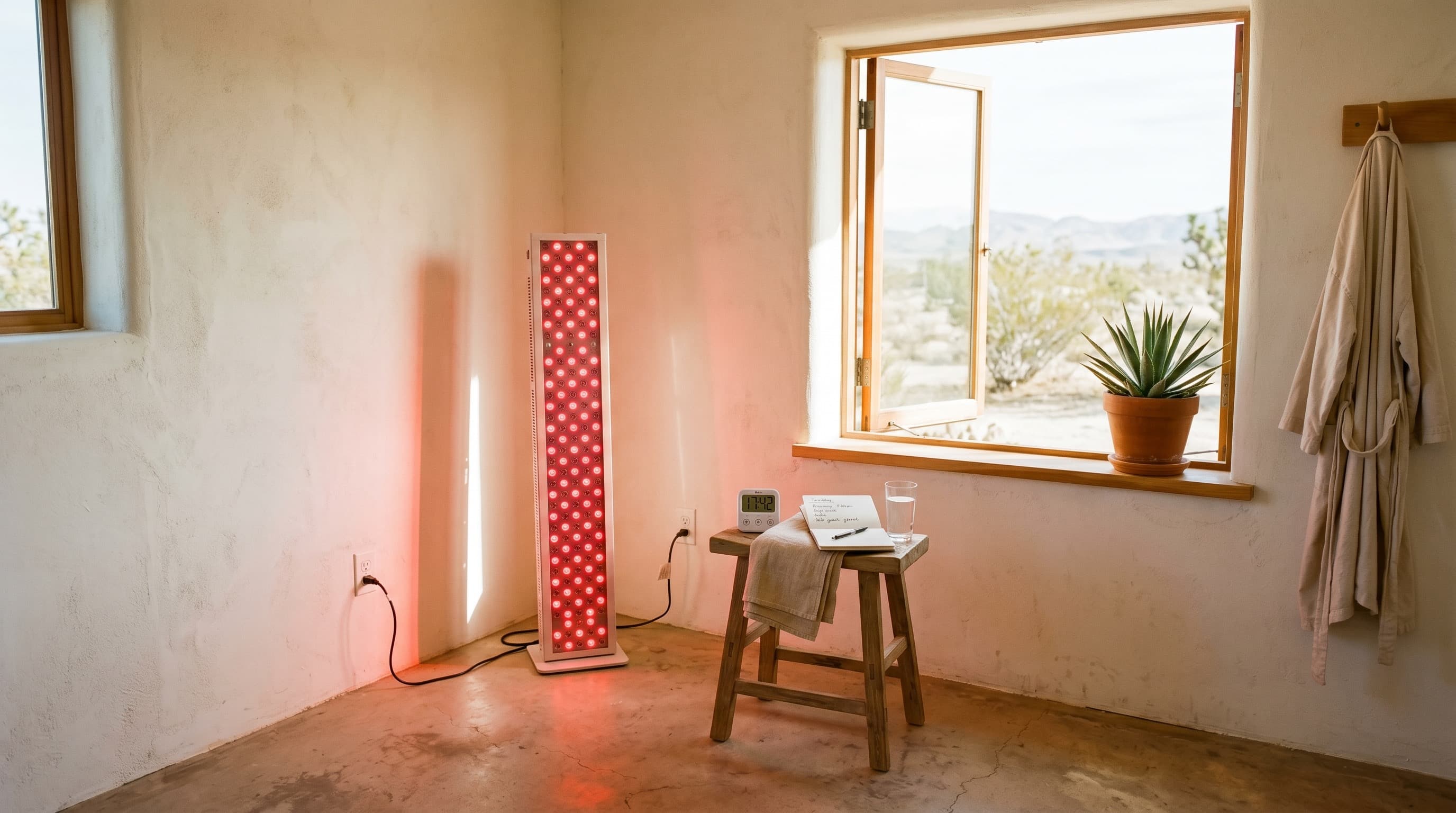
Whole-body red/NIR light-bed exposure, where light reaches cells, changes how mitochondria handle energy and stress signals, and can release nitric oxide that relaxes blood vessels.
A cautious, explicitly logged whole-body red/NIR routine can support a gated measurement-first field test, not a validated sleep or recovery intervention.
Whole-body red and near-infrared photobiomodulation is plausible enough for a careful measurement-first field test, but the direct evidence for this exact general variant is still limited, adjacent, device-specific, and parameter-sensitive.
Much of the stronger or more positive literature belongs to sibling variants, adjacent modalities, or narrow populations rather than to a general healthy-adult whole-body protocol.
Sources checked is every card shown on this page. Direct human participants counts only primary human studies with coded participant totals, deduplicated by cohort when possible. Review cards may show larger pooled head counts on their own rows, and those pooled totals are treated as approximate rather than added into the page-level number.
Whole-body photobiomodulation should stay separate from localized PBM, red-light glasses, bright-light therapy, infrared sauna, and UV-tanning protocols.
6 sources · 4 reviews · 1 guidance source · 1 supporting source
Far-infrared sauna evidence suggests some cardiovascular or pain signals but also clear null findings, and it belongs to a thermal-sauna intervention class rather than nonthermal PBM.
Human transcranial PBM studies report altered brain activity and regional blood flow, but the exposure geometry is focal and head-only.
Bright-light therapy in insomnia showed pooled benefit mainly for wake after sleep onset, with no clear pooled benefit for several other sleep metrics.
Cochrane blue-light filtering lens evidence is an adjacent light-intervention boundary, not whole-body red/NIR PBM evidence.
IARC classifies UV-emitting tanning devices as carcinogenic to humans.
This consensus says PBM is generally safe when used as directed, emphasizes red and NIR wavelength ranges, and treats parameter reporting as essential rather than optional.
Direct whole-body sleep evidence is sparse; the closest controlled wellness trial is adjacent partial-body and null for sleep or circadian benefit, while direct whole-body sleep registries mostly contribute implementation context. The acute women-only metabolic crossover is direct whole-body exposure, but it should stay as metabolic context rather than sleep-efficacy evidence.
4 sources · 4 trials
Registry includes a direct whole-body PBM arm in older adults, but no outcome results are available in the record used here.
Registry describes a direct NovoTHOR whole-body PBM implementation for sleep and performance, but no outcome results are available in the record used here.
A single 12-minute whole-body red and near-infrared PBM session increased resting energy expenditure in women with obesity, but not as a generic across-population efficacy signal.
Highest-dose daytime 850 nm PBM improved mood, drowsiness, IFN-gamma, and resting heart rate in winter, but did not improve sleep or circadian outcomes.
Several extracted whole-body implementations use 12- to 20-minute sessions and 2–3 or 3 sessions per week, but these are device- and population-specific examples rather than a standardized dose; parameter standardization is poor and explicit dose logging matters.
8 sources · 5 trials · 2 reviews · 1 guidance source
Open-label long-COVID pilot reported cognitive and qEEG improvements after both transcranial and whole-body PBM, but the mixed-modality, no-placebo design keeps it out of direct protocol claims.
Registry includes a direct whole-body PBM arm in older adults, but no outcome results are available in the record used here.
The review argues LEDs are a durable PBM delivery class with practical advantages for large-area treatment, but laser and LED outputs should not be treated as automatically equivalent.
This review frames PBM efficacy as highly parameter-sensitive, with contradictory findings often linked to wavelength, fluence, irradiance, pulsing, and repetition differences.
Registry describes a direct NovoTHOR whole-body PBM implementation for sleep and performance, but no outcome results are available in the record used here.
A single 12-minute whole-body red and near-infrared PBM session increased resting energy expenditure in women with obesity, but not as a generic across-population efficacy signal.
Protocol defines a 12-session whole-body NovoTHOR versus placebo fibromyalgia RCT with extensive follow-up and mechanistic endpoints.
This consensus says PBM is generally safe when used as directed, emphasizes red and NIR wavelength ranges, and treats parameter reporting as essential rather than optional.
Athlete and exercise-timed recovery literature is mixed and includes null or trade-off signals, while fibromyalgia, chronic-pain, and cosmetic large-area PBM literatures are condition- or endpoint-specific and should remain separate from the general Murph variant.
10 sources · 7 trials · 2 reviews · 1 observational study
Systematic review of chronic-pain RCTs found many positive pain signals and generally low reported adverse-event burden, but directness to whole-body red/NIR exposure was low.
Season-long full-body PBM use was associated with lower sleeping heart rate, but also with shorter total and REM sleep on post-treatment nights.
Pre- and post-exercise whole-body light-bed PBM did not significantly lower creatine kinase or salivary interleukin-6 after intense resistance exercise.
Twenty minutes of whole-body PBM before repeated Wingate cycling did not improve performance, lactate, perceived recovery, or most physiological responses, but next-morning rMSSD was higher than after placebo.
Protocol defines a 12-session whole-body NovoTHOR versus placebo fibromyalgia RCT with extensive follow-up and mechanistic endpoints.
Single-arm fibromyalgia feasibility trial reported acceptable delivery and broad symptom improvement after 18 whole-body PBMT sessions.
Across five athlete studies, whole-body PBM showed limited sleep-related signals but no convincing benefit for exercise performance or recovery biomarkers.
Large-area and full-body polychromatic PBM improved cosmetic skin outcomes versus control, but broader 570–850 nm output did not outperform red-only treatment.
Short-term placebo-controlled fibromyalgia RCT found significant benefit on pain, quality of life, kinesiophobia, and self-efficacy after whole-body PBM.
Longer-term placebo-controlled fibromyalgia RCT reported benefits across pain, quality of life, activity, kinesiophobia, and self-efficacy after whole-body PBM.
Eye safety, high-local-dose skin reactions, photosensitizing and healing-risk medications, oncology context, thyroid and skin-boundary exclusions, and registry exclusion patterns for pregnancy or lactation, seizure risk, pacemakers or implanted devices, unstable cardiovascular, metabolic, neurologic, pulmonary, or psychiatric disease all argue for stronger screening than the internet red-light narrative usually uses.
22 sources · 8 reviews · 6 supporting sources · 4 trials
Parkinson's registry plans about 30 whole-body PBM sessions over 10 weeks with motor, balance, cognitive, and safety endpoints.
Hypertension registry compares one full-body 660 nm LED panel session against modified ILIB and matched sham on acute vascular endpoints.
Triple-blind placebo-controlled diabetes registry plans 20-minute whole-body PBM sessions with fasting glucose, HbA1c, and sleep-quality follow-up.
COPD crossover registry uses Joovv Elite whole-body light and sham to study dyspnea, fatigue, functional tests, and respiratory pressures.
Dose-response diabetes registry specifies 10-, 20-, and 30-minute 850 nm whole-body PBM tiers with capillary glucose monitoring through 24 hours.
Practical guidance recommends especially strict delays after photodynamic therapy drugs, while many other photosensitizing medications warrant caution, test spots, and wavelength review rather than automatic exclusion.
Registry describes a direct NovoTHOR whole-body PBM implementation for sleep and performance, but no outcome results are available in the record used here.
This registry studies how much 660 nm and 850 nm light is reflected during non-contact whole-body PBM across skin phototype and sex, but it does not report clinical efficacy outcomes.
Cancer-PBM literature remained mixed at the preclinical level, which is why oncology exposure should stay in a supervised safety-boundary bucket.
Drug-induced photosensitivity can involve UV and visible light, so medication screening matters even when a protocol is not UV-based.
The small literature identified no reported complications from laser treatment in patients taking photosensitizing medication, but only four publications were found.
The WALT position paper reports robust supportive-care PBM evidence with no demonstrated clinical adverse events, but still calls for caution in cancer populations and long follow-up.
Facial light and laser procedures can cause conjunctival, corneal, and retinal injuries when protection is inadequate or positioning is poor.
Light therapy appeared ophthalmologically safe in physically healthy, unmedicated people, but one photosensitized maculopathy case and poor reporting justify conservative eye-safety language.
Across 27 included supportive-care oncology PBMT reports, most studies reported no side effects and the review did not identify a tumor-safety signal.
In vitro oncology PBMT signals were conflicting, but in vivo and clinical studies with follow-up generally supported safety regarding tumor growth at recommended parameters.
In a 30-participant single-arm neck-device study, 16 weeks of 630/850 nm exposure showed no significant thyroid or parathyroid changes while local wrinkle and skin measures improved.
Two red-light myopia devices approached or exceeded retinal photochemical safety limits during intended continuous viewing.
Across pediatric red-light myopia studies, no irreversible visual harm was identified, but reversible retinal findings and afterimages justify monitoring.
Human red-LED skin exposure was tolerated without serious adverse events, but dose-limiting blistering and prolonged erythema appeared at higher fluences and tolerability differed by race or ethnicity.
In 693 HCT patients followed up to 15 years, PBMT for oral mucositis was not associated with immediate adverse effects or oral secondary malignancy.
A sham-controlled neck-device trial found better investigator-rated wrinkle outcomes and no thyroid-related complications, but participant-rated GAIS did not clearly separate groups.
An early 590 nm full-panel facial photomodulation cohort reported photoaging improvement in 90% of participants with no side effects noted. The 590nm Photoaging Cohort group currently links one appraisal-backed source with adjacent variant scope and positive interpretation; use the linked appraisals for source-specific caveats.
1 source · 1 observational study
An early 590 nm full-panel facial photomodulation cohort reported photoaging improvement in 90% of participants with no side effects noted.
Eight 590 nm full-face LED treatments were associated with clinical, profilometric, and histologic photoaging improvements. The 590nm Photoaging Trial group currently links one appraisal-backed source with adjacent variant scope and positive interpretation; use the linked appraisals for source-specific caveats.
1 source · 1 trial
Eight 590 nm full-face LED treatments were associated with clinical, profilometric, and histologic photoaging improvements.
Combined 633 nm and 830 nm facial LED therapy improved wrinkle-related profilometry and patient-reported softness in a small single-arm study. The 633 830 Facial Single Arm group currently links one appraisal-backed source with adjacent variant scope and positive interpretation; use the linked appraisals for source-specific caveats.
1 source · 1 trial
Combined 633 nm and 830 nm facial LED therapy improved wrinkle-related profilometry and patient-reported softness in a small single-arm study.
Nine combined 633/830 nm facial LED treatments were associated with wrinkle improvement and thicker collagen fibers on electron microscopy. The 633 830 Photoaged Skin group currently links one appraisal-backed source with adjacent variant scope and positive interpretation; use the linked appraisals for source-specific caveats.
1 source · 1 trial
Nine combined 633/830 nm facial LED treatments were associated with wrinkle improvement and thicker collagen fibers on electron microscopy.
A facial rejuvenation frequency trial found null photographic wrinkle-score differences but positive ImageJ and satisfaction signals, with no clear gain from the higher session frequency. The 660nm Frequency Facial RCT group currently links one appraisal-backed source with adjacent variant scope and mixed interpretation; use the linked appraisals for source-specific caveats.
1 source · 1 trial
A facial rejuvenation frequency trial found null photographic wrinkle-score differences but positive ImageJ and satisfaction signals, with no clear gain from the higher session frequency.
Bright-light therapy showed modest antidepressant benefit in seasonal affective disorder, but this is bright-light psychiatry evidence rather than whole-body PBM evidence. The Bright Light Therapy Boundary group currently links one appraisal-backed source with adjacent variant scope and positive interpretation; use the linked appraisals for source-specific caveats.
1 source · 1 review
Bright-light therapy showed modest antidepressant benefit in seasonal affective disorder, but this is bright-light psychiatry evidence rather than whole-body PBM evidence.
Protocol outlines a supervised NHS whole-body NovoTHOR feasibility pathway for chronic pain, but no efficacy results are reported. The Chronic Pain Feasibility Protocol group currently links one appraisal-backed source with clinical supervised scope and not efficacy evidence interpretation; use the linked appraisals for source-specific caveats.
1 source · 1 supporting source
Protocol outlines a supervised NHS whole-body NovoTHOR feasibility pathway for chronic pain, but no efficacy results are reported.
NIHR listing confirms a UK whole-body PBM chronic-pain study, but it does not contribute extracted outcome results. The Chronic Pain Nihr Registry group currently links one appraisal-backed source with clinical supervised scope and not efficacy evidence interpretation; use the linked appraisals for source-specific caveats.
1 source · 1 trial
NIHR listing confirms a UK whole-body PBM chronic-pain study, but it does not contribute extracted outcome results.
The review describes preliminary antidepressant and mechanistic signals for transcranial or systemic PBM, but evidence quality was limited and not specific to whole-body exposure. The Clinical Psychiatric PBM Boundary group currently links one appraisal-backed source with same mechanism scope and mixed interpretation; use the linked appraisals for source-specific caveats.
1 source · 1 review
The review describes preliminary antidepressant and mechanistic signals for transcranial or systemic PBM, but evidence quality was limited and not specific to whole-body exposure.
A sham-controlled 630/850 nm periocular mask trial found significant wrinkle-score improvements and described treatment as safe, well tolerated, and painless. The Crows Feet Mask RCT group currently links one appraisal-backed source with general guideline scope and positive interpretation; use the linked appraisals for source-specific caveats.
1 source · 1 trial
A sham-controlled 630/850 nm periocular mask trial found significant wrinkle-score improvements and described treatment as safe, well tolerated, and painless.
This dermatology LED meta-analysis showed strong pooled acne effects and positive direction for some yellow/NIR applications, but important heterogeneity for other conditions. The Dermatology Led Meta Analysis group currently links one appraisal-backed source with general guideline scope and mixed interpretation; use the linked appraisals for source-specific caveats.
1 source · 1 review
This dermatology LED meta-analysis showed strong pooled acne effects and positive direction for some yellow/NIR applications, but important heterogeneity for other conditions.
A dermatology LED review found generally few reported adverse events, but the evidence base was heterogeneous and often methodologically weak. The Dermatology Led RCT Review group currently links one appraisal-backed source with general guideline scope and not efficacy evidence interpretation; use the linked appraisals for source-specific caveats.
1 source · 1 review
A dermatology LED review found generally few reported adverse events, but the evidence base was heterogeneous and often methodologically weak.
Recommendations paper argues that PBMT has a dose window and that future sports trials need stronger reporting, but it is built mainly on localized PBMT evidence rather than whole-body trials. The Exercise Pbmt Guideline group currently links one appraisal-backed source with general guideline scope and not efficacy evidence interpretation; use the linked appraisals for source-specific caveats.
1 source · 1 guidance source
Recommendations paper argues that PBMT has a dose window and that future sports trials need stronger reporting, but it is built mainly on localized PBMT evidence rather than whole-body trials.
Nightly whole-body red-light exposure improved sleep quality, increased serum melatonin, and improved 12-minute run performance in elite female basketball players. The Female Basketball Red Light RCT group currently links one appraisal-backed source with adjacent variant scope and positive interpretation; use the linked appraisals for source-specific caveats.
1 source · 1 trial
Nightly whole-body red-light exposure improved sleep quality, increased serum melatonin, and improved 12-minute run performance in elite female basketball players.
Placebo-controlled fibromyalgia RCT reported physiologic changes in circadian blood pressure, tenderness thresholds, and tissue elasticity after whole-body PBM. The Fm Circadian Mechanistic RCT group currently links one appraisal-backed source with clinical supervised scope and positive interpretation; use the linked appraisals for source-specific caveats.
1 source · 1 trial
Placebo-controlled fibromyalgia RCT reported physiologic changes in circadian blood pressure, tenderness thresholds, and tissue elasticity after whole-body PBM.
Registry identifies a completed whole-body PBM fibromyalgia trial focused on circadian blood pressure, but no extracted results are included here. The Fm Circadian Registry group currently links one appraisal-backed source with clinical supervised scope and not efficacy evidence interpretation; use the linked appraisals for source-specific caveats.
1 source · 1 trial
Registry identifies a completed whole-body PBM fibromyalgia trial focused on circadian blood pressure, but no extracted results are included here.
Qualitative interviews described a positive recovery-like process during whole-body PBMT, but this is experiential rather than controlled efficacy evidence. The Fm Experience Analysis group currently links one appraisal-backed source with clinical supervised scope and not efficacy evidence interpretation; use the linked appraisals for source-specific caveats.
1 source · 1 supporting source
Qualitative interviews described a positive recovery-like process during whole-body PBMT, but this is experiential rather than controlled efficacy evidence.
Scoping review mapped promising but heterogeneous fibromyalgia PBMT evidence and argued that many NICE concerns may be addressable by existing literature. The Fm Pbmt Scoping Review group currently links one appraisal-backed source with same mechanism scope and not efficacy evidence interpretation; use the linked appraisals for source-specific caveats.
1 source · 1 review
Scoping review mapped promising but heterogeneous fibromyalgia PBMT evidence and argued that many NICE concerns may be addressable by existing literature.
Fibromyalgia systematic review reported overall PBMT benefit and suggested more sustained effects for whole-body delivery than localized treatment. The Fm Pbmt Systematic Review group currently links one appraisal-backed source with adjacent variant scope and mixed interpretation; use the linked appraisals for source-specific caveats.
1 source · 1 review
Fibromyalgia systematic review reported overall PBMT benefit and suggested more sustained effects for whole-body delivery than localized treatment.
Registry identifies the sham-controlled fibromyalgia whole-body PBM program but does not contribute extracted outcome results here. The Fm RCT Registry group currently links one appraisal-backed source with clinical supervised scope and not efficacy evidence interpretation; use the linked appraisals for source-specific caveats.
1 source · 1 trial
Registry identifies the sham-controlled fibromyalgia whole-body PBM program but does not contribute extracted outcome results here.
Commentary argues PBM may improve sleep, especially via nocturnal transcranial mechanisms, but it does not provide direct whole-body efficacy data. The Foundational Sleep PBM Commentary group currently links one appraisal-backed source with same mechanism scope and not efficacy evidence interpretation; use the linked appraisals for source-specific caveats.
1 source · 1 review
Commentary argues PBM may improve sleep, especially via nocturnal transcranial mechanisms, but it does not provide direct whole-body efficacy data.
Intranasal PBM is positioned as a distinct local or systemic-adjacent PBM strategy, not as whole-body exposure. The Intranasal PBM Boundary group currently links one appraisal-backed source with same mechanism scope and not efficacy evidence interpretation; use the linked appraisals for source-specific caveats.
1 source · 1 review
Intranasal PBM is positioned as a distinct local or systemic-adjacent PBM strategy, not as whole-body exposure.
NICE concluded that evidence for intranasal phototherapy in allergic rhinitis was limited in quantity and quality and should remain in research settings. The Intranasal Phototherapy Boundary group currently links one appraisal-backed source with clinical supervised scope and not efficacy evidence interpretation; use the linked appraisals for source-specific caveats.
1 source · 1 guidance source
NICE concluded that evidence for intranasal phototherapy in allergic rhinitis was limited in quantity and quality and should remain in research settings.
This commentary emphasizes that existing in vivo and clinical PBMT evidence is more relevant than theoretical in vitro concern when judging tumor safety. The Oncology Commentary Evidence Hierarchy group currently links one appraisal-backed source with same mechanism scope and not efficacy evidence interpretation; use the linked appraisals for source-specific caveats.
1 source · 1 supporting source
This commentary emphasizes that existing in vivo and clinical PBMT evidence is more relevant than theoretical in vitro concern when judging tumor safety.
Localized PBM was recommended for prevention of oral mucositis in specific supervised oncology settings, with no general treatment recommendation and no parameter interchangeability. The Oral Oncology PBM Boundary group currently links one appraisal-backed source with clinical supervised scope and mixed interpretation; use the linked appraisals for source-specific caveats.
1 source · 1 guidance source
Localized PBM was recommended for prevention of oral mucositis in specific supervised oncology settings, with no general treatment recommendation and no parameter interchangeability.
Umbrella review found the strongest fibromyalgia support for fatigue, while several other fibromyalgia endpoints remained low or very low certainty or nonsignificant. The PBM Umbrella Review group currently links one appraisal-backed source with same mechanism scope and mixed interpretation; use the linked appraisals for source-specific caveats.
1 source · 1 review
Umbrella review found the strongest fibromyalgia support for fatigue, while several other fibromyalgia endpoints remained low or very low certainty or nonsignificant.
Suspended registry describes an acute rugby crossover protocol testing whole-body PBM before isokinetic fatigue and DOMS assessment, but no results are posted. The Rugby Isokinetic Registry group currently links one appraisal-backed source with adjacent variant scope and not efficacy evidence interpretation; use the linked appraisals for source-specific caveats.
1 source · 1 trial
Suspended registry describes an acute rugby crossover protocol testing whole-body PBM before isokinetic fatigue and DOMS assessment, but no results are posted.
Review says PBM-sleep research is promising but still early, heterogeneous, and under-standardized. The Sleep PBM Review Context group currently links one appraisal-backed source with same mechanism scope and not efficacy evidence interpretation; use the linked appraisals for source-specific caveats.
1 source · 1 review
Review says PBM-sleep research is promising but still early, heterogeneous, and under-standardized.
Completed registry materials suggest timing-dependent benefits for CK and soreness, but neither pre- nor post-exercise whole-body PBM improved muscle performance. The Soccer Prepost Sham Registry group currently links one appraisal-backed source with adjacent variant scope and mixed interpretation; use the linked appraisals for source-specific caveats.
1 source · 1 trial
Completed registry materials suggest timing-dependent benefits for CK and soreness, but neither pre- nor post-exercise whole-body PBM improved muscle performance.
Narrative review summarizes potential sports benefits and mechanisms for PBM, while emphasizing that dosage and treatment parameters are not yet standardized. The Sports PBM Narrative Review group currently links one appraisal-backed source with same mechanism scope and not efficacy evidence interpretation; use the linked appraisals for source-specific caveats.
1 source · 1 review
Narrative review summarizes potential sports benefits and mechanisms for PBM, while emphasizing that dosage and treatment parameters are not yet standardized.
Recruiting registry describes a season-long whole-body PBM soccer protocol with repeated soreness, strength, jump, blood-count, and PSQI endpoints, but no outcomes are available yet. The State Championship Soccer Registry group currently links one appraisal-backed source with adjacent variant scope and not efficacy evidence interpretation; use the linked appraisals for source-specific caveats.
1 source · 1 trial
Recruiting registry describes a season-long whole-body PBM soccer protocol with repeated soreness, strength, jump, blood-count, and PSQI endpoints, but no outcomes are available yet.
This editorial supports using photobiomodulation therapy terminology rather than older low-level light or laser labels. The Terminology Standardization group currently links one appraisal-backed source with same mechanism scope and not efficacy evidence interpretation; use the linked appraisals for source-specific caveats.
1 source · 1 supporting source
This editorial supports using photobiomodulation therapy terminology rather than older low-level light or laser labels.
Recruiting registry tests acute full-body PBM against placebo in trained men with torque, fatigue, agility, soreness, and perceived recovery outcomes. The Trained Dynamometry Agility Registry group currently links one appraisal-backed source with adjacent variant scope and not efficacy evidence interpretation; use the linked appraisals for source-specific caveats.
1 source · 1 trial
Recruiting registry tests acute full-body PBM against placebo in trained men with torque, fatigue, agility, soreness, and perceived recovery outcomes.
Meta-analysis found better cognitive performance after transcranial PBM in young healthy adults, but the intervention was focal brain-directed PBM rather than whole-body exposure. The Transcranial PBM Boundary group currently links one appraisal-backed source with same mechanism scope and positive interpretation; use the linked appraisals for source-specific caveats.
1 source · 1 review
Meta-analysis found better cognitive performance after transcranial PBM in young healthy adults, but the intervention was focal brain-directed PBM rather than whole-body exposure.
WHO places artificial tanning devices in a UV-risk and public-health-regulation domain rather than a therapeutic PBM domain. USPSTF recommends counseling to reduce ultraviolet exposure and avoid indoor tanning, reinforcing the UV-risk boundary. The UV Tanning Safety Boundary group currently links 2 appraisal-backed sources with general guideline scope and not efficacy evidence interpretation; use the linked appraisals for source-specific caveats.
2 sources · 2 guidance sources
USPSTF recommends counseling to reduce ultraviolet exposure and avoid indoor tanning, reinforcing the UV-risk boundary.
WHO places artificial tanning devices in a UV-risk and public-health-regulation domain rather than a therapeutic PBM domain.
Five-minute full-body PBM after matches did not improve most hormonal, inflammatory, autonomic, strength, or jump recovery measures in young water polo athletes. The Water Polo Postmatch RCT group currently links one appraisal-backed source with adjacent variant scope and no clear advantage interpretation; use the linked appraisals for source-specific caveats.
1 source · 1 trial
Five-minute full-body PBM after matches did not improve most hormonal, inflammatory, autonomic, strength, or jump recovery measures in young water polo athletes.