
Loading dashboard
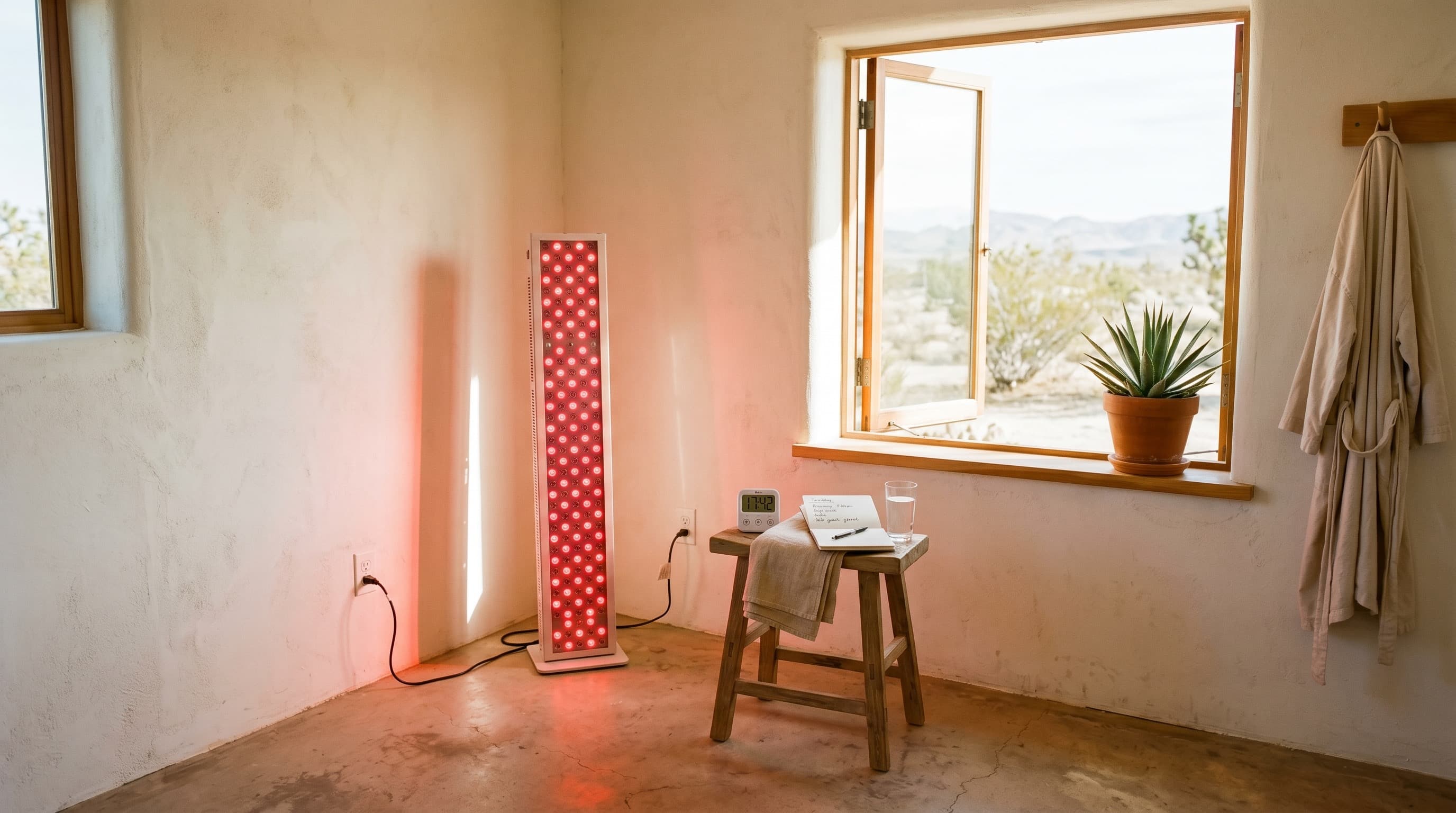
Whole-body red/NIR light-bed exposure, where light reaches cells, changes how mitochondria handle energy and stress signals, and can release nitric oxide that relaxes blood vessels.
Red/NIR exposure supports nitric-oxide signaling and inflammatory balance, lowering overnight recovery demand and resting pulse.
limited evidence
Lower recovery load gives the vagal system more room to rebound during sleep, raising RMSSD.
limited evidence
red/NIR exposure
Confirm device is documented non-UV non-tanning, nonthermal red/NIR PBM; exclude sauna, tanning, IPL, laser, and heat protocols.
Complete safety screen before start; route avoid/clinician-guidance items away from routine wellness setup.
Use beginner/manufacturer setting and the lower of device instructions and Murph range; do not increase dose to chase effect.
Record device wavelengths, irradiance/fluence if known, intensity, pulsing, duration, geometry, coverage, and session orientation.
Choose 1 stable session window; keep device duration, timing, coverage, distance, and body position consistent.
Use device-appropriate eye protection; avoid direct emitter gaze and keep sessions clearly nonthermal.
Log symptoms visual effects, skin changes, mood, sleep changes, medication changes, and confounders after each session.
Stop for eye skin, heat, mood, cardiopulmonary, neurologic, or severe symptoms; missed sessions beat pushing through.
To keep results clean
Report parameters, not marketing language. Wavelength alone is not the whole dose.
Keep device duration, timing, and coverage steady so a null result is still interpretable.
Pair wearable data with one-tap subjective ratings for sleep sleepiness, and recovery.
A flat or negative result is useful information not proof you did it wrong.
Anything unclear during the protocol? Ask Murph — your plan, baseline, and tracked signals are already loaded.
Red/NIR PBM depends on wavelength, irradiance, fluence, duration, distance, and coverage. Marketing color names do not define the biological exposure.
Photons affect mitochondrial, nitric-oxide, inflammatory, and oxidative-stress pathways. The effect is nonthermal; heat turns it into a different protocol.
Large-area exposure can change autonomic or vascular tone. Resting HR and RMSSD track whether recovery load drops without overclaiming sleep or performance.
Whole-body red/NIR PBM · 3x/week · nonthermal
Photons affect mitochondrial, nitric-oxide, and inflammatory signaling
Large-area cell signal repeats with same geometry and dose
Recovery load drops · vascular tone eases · RHR and RMSSD track response