Build Muscle After 50
Build and keep muscle after 50 with progressive training, enough food, and recovery that fits your life.
 Ask Murph to help
You can build muscle and strength well beyond 50. Pace, recovery, and starting point may differ from earlier decades, but the basic signal still works: challenge the muscles, repeat the work, eat enough, and progress gradually, so capability lasts.
Resistance training also helps with what matters more than a body-composition number: getting out of a chair, climbing stairs, carrying groceries, balance, and hobbies. A program should improve those abilities, not leave you so sore that normal life shrinks around it.
What to do
- Train all major muscle groups at least twice a week.
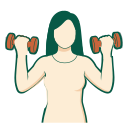
- Use machines, free weights, bands, or bodyweight, depending on access and confidence. All provide useful resistance.
- Start with two working sets per exercise and earn more volume through consistent recovery.
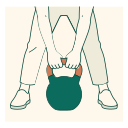
- Across the week, include squatting or standing, hinging, pushing, pulling, carrying, and calf or ankle work.
- Eat protein-rich foods at most meals, and avoid chronic under-eating when muscle gain is the aim.
- When safe, keep some faster but controlled intent, like standing up briskly or lifting a moderate load with purpose. Power matters for function.
Age alone doesn't mean tiny weights. The right load challenges you and stays under control. Heavier resistance often has an edge for maximal strength, while a wide range of loads can build muscle. Start conservatively and progress on performance, not a stereotype.
A simple plan
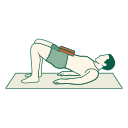
On Monday and Thursday, do five movements: a chair squat or leg press, a hip hinge or bridge, a chest press or push-up, a row or pulldown, and a carry or calf raise. For the first two weeks, do two sets of 6 to 12 reps with about three good reps in reserve.
When you reach the top of the range with steady technique, add the smallest amount of resistance. If balance limits a leg exercise, use a rail or machine so every set isn't a balance test. Practice balance separately if that is also a goal.
Walk or do aerobic activity you enjoy on other days, but keep at least one genuinely easy day a week. After four weeks, if recovery is good, add one set to the exercises closest to your goal. Keep sessions under an hour unless you enjoy longer ones.
Nutrition doesn't need to become a supplement project. Build meals around a useful protein source, include plants and enough energy, and talk to a clinician or dietitian before major diet changes if you have kidney disease, unintentional weight loss, chewing trouble, or appetite loss.
How to know it is working
Track a lower-body movement, a push, and a pull. More reps, resistance, range, or control are clear signs. Also watch function: chair rises, stair climbing, walking with a load, and floor transfers may improve before a home body-composition device notices anything.
If size matters to you, use circumference, standardized photos, or a professionally interpreted body-composition measure at sensible intervals. Daily smart-scale lean-mass changes mostly reflect water. Review the trend every eight to twelve weeks.
If you get stuck
The first suspect is usually too little progression: the same comfortable weights, repeated indefinitely. The second is too much too soon, which brings lingering soreness and missed sessions. Adjust in small steps. If performance drops over several weeks, cut volume briefly and review sleep, food, illness, medication changes, and total activity.
Joint limitations don't necessarily mean stopping; a machine, reduced range, different grip, or supported version may still allow productive training. Persistent weakness, repeated falls, unexplained weight loss, or rapid loss of function deserves medical assessment, not a harder program.