Build Core Strength
Build a trunk that can brace, carry, rotate, and transfer force without endless crunches.
 Ask Murph to help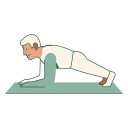
The trunk resists unwanted movement, creates movement when needed, and passes force between the hips and shoulders. No single muscle does all that, and no single plank trains it. A useful program covers bracing, side-to-side control, rotation, carrying, and sometimes flexion or extension. No one drill is the secret to a healthy back.
Core work should serve a purpose. For a stronger squat or deadlift, practice bracing under gradually heavier loads. If carrying a child or suitcase is hard, train carries. For a rotational sport, build control first, then add faster, sport-specific rotation.
What to do
- Train the trunk two or three times a week, often at the end of a strength session.
- Across the week, include an anti-extension exercise, a side-support or anti-lateral-flexion exercise, and a carry or anti-rotation exercise.
- Keep sets short and clean. End a hold when position slips, not when the clock says so.
- Breathe behind the brace. Tension should not require a long breath hold every set.
- Progress lever length, resistance, distance, or control instead of adding minutes forever.
- Keep training the rest of the body; squats, hinges, rows, presses, and carries already work the trunk.
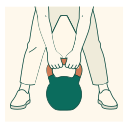
Dead bugs, bird dogs, side planks, front planks, Pallof presses, suitcase carries, farmer carries, cable lifts and chops, and controlled rollouts all work. Choose a version that challenges the trunk while your ribcage and pelvis stay put.
A simple plan
Twice a week, do three exercises after your main lifts. On the first day, do a dead bug for 6 to 10 controlled reps per side, a side plank for 15 to 30 seconds per side, and a suitcase carry for 20 to 40 steps per side. On the second day, use a bird dog, Pallof press, and farmer carry.
Start with two sets. Make each rep deliberate and stop before shaking turns into lost position. When the top of the range is clean, use a slightly longer lever, a little more resistance, or a longer carry. For holds, add load or difficulty instead of chasing a five-minute plank.
If the point is a stronger main lift, practice there. Before a squat or deadlift set, take one breath, expand the trunk in all directions, brace as if for a firm bump, and hold that pressure through the hard part of the rep. Keep the load light enough to practice with.
How to know it is working
Progress shows up as better control in a harder variation, more load on a carry, a steadier single-side exercise, or more confidence under a compound lift. Daily tasks may feel less wobbly, but stronger abs won't automatically get rid of pain.
Pick two anchor exercises and reassess monthly. A plank time is useful if the position is standardized, but it measures endurance in that plank, not some universal core strength. Pair it with a carry or a dynamic control task.
If you get stuck
If the hip flexors, shoulders, or low back always tire first, make the exercise easier and restore the intended position. Shorter levers, a raised plank, or a lighter carry put the work back on the trunk. If long holds bring no carryover, stop extending the clock and make the challenge more specific.
If back discomfort is why you started, core exercise is one option within a broader approach. Walking, general strength, sleep, stress, and a gradual return to meaningful activity may matter too. Persistent or radiating symptoms should not be reduced to a weak-core story.