Deadlift More Weight
Build a stronger deadlift with specific practice, stronger hips and back, and manageable fatigue.
 Ask Murph to help
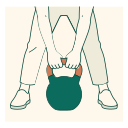
Deadlift strength depends on a repeatable setup, strong hip and knee extension, enough grip and trunk strength, and a program that respects fatigue. Heavy sets are demanding, so the lift can improve with surprisingly little maximal work.
Decide which lift you mean. Conventional, sumo, trap-bar, and Romanian deadlifts have different purposes and numbers. For a competition lift, practice that exact lift. For general strength, pick the version that fits your body, equipment, and confidence.
What to do
- Practice the primary deadlift once or twice a week.
- Set the feet, grip, breath, and bar position the same way before every rep.
- Do most training below maximal effort, with one to three good reps in reserve.
- Strengthen the hinge with Romanian deadlifts, hip extensions, or hamstring work, and build leg drive with squats or split squats.
- Train the upper back and grip, but use straps on accessory sets when grip would otherwise keep the hips and back from getting useful work.
- Add load in small steps and avoid frequent one-rep-max attempts.
Heavy work is specific to maximal strength, but moderate-load sets build the muscle and technique behind it. Low-rep practice plus higher-rep accessory work is usually easier to recover from than making every deadlift set heavy.
A simple plan
On the primary day, do three sets of 3 to 5 reps in the exact deadlift you want to improve, stopping with about two good reps in reserve. Follow with two sets of a squat or split squat and two sets of a row. On a second day, do a Romanian deadlift or lighter deadlift variation for three sets of 6 to 8, plus hamstring or hip-extension work.
When all primary sets reach five controlled reps with the same start position, add the smallest practical load and return to three. Progress accessories within their ranges. Every fourth to sixth week, reduce deadlift volume or load if fatigue is building.
Film one working set from a side-front angle. Look for the bar starting close to the body, tension before it leaves the floor, and a finish made by standing tall rather than leaning far back. Back position varies normally between people. You want a controlled position you can repeat, not one geometric template.
How to know it is working
Track a repeatable triple or set of five. More weight at the same effort, more reps at the same weight, or a faster, cleaner set all count. Note straps, belt, bar type, and whether reps reset on the floor, because those choices change the number.
Grip, sleep, yesterday's training, and even the plates or bar can change performance. Judge six- to eight-week trends. A one-day estimated max is a rough tool, not an identity or an excuse to ignore poor technique.
If you get stuck
If the bar won't leave the floor, review the setup, leg strength, and whether the warm-up is already tiring you out. If the lift stalls above the knee, hip extension and upper-back strength may need work. Pick an accessory that matches a visible limitation, not a fashionable variation chosen at random.
If performance drops and the low back stays fatigued, reduce volume before adding it. Deadlifts overlap with squats, rows, loaded carries, running, and physical work, so one high-quality primary session may be enough during a demanding season. If grip alone fails, train it separately and use straps on non-competition work where it makes sense.