Carry Heavy Things More Easily
Build grip, leg, trunk, and shoulder strength for groceries, luggage, equipment, and everyday loads.
 Ask Murph to help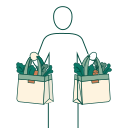
Carrying is a whole-body skill. The hands hold the object, the shoulders keep it organized, the trunk resists tipping, and the legs move the load. Carries themselves are the most specific training, but squats, hinges, rows, grip work, and walking fitness all contribute.
Match training to the carry you actually need. Two grocery bags are a farmer carry. A suitcase is a one-sided carry. A child or awkward box needs a front carry and good pickup technique. The load doesn't have to be a gym implement for the training to be specific.
What to do
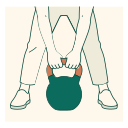
- Practice a two-handed farmer carry and a one-handed suitcase carry once or twice a week.
- Build squat and hinge strength so picking the load up isn't the hardest part.
- Train rows or pulldowns and grip so the shoulders and hands don't fail early.
- Use short trips with excellent control before adding distance.
- Match handle size, object shape, and carrying position to real life when practical.
- Increase load or distance, not both at once.
Walk normally instead of taking tiny rushed steps. Keep the object close, turn deliberately, and set it down with the same care you used to pick it up. A one-sided carry should challenge the trunk without forcing a big lean.
A simple plan
Twice a week after strength training, do three farmer carries of 20 to 40 steps, resting until grip and breathing recover. Then do two suitcase carries per side for 15 to 30 steps. Start with a load you can move without the shoulders sagging or the objects hitting your legs.
Add five steps per round until the top of the range feels controlled, then add a little weight and return to the lower distance. Also train a squat or step-up, a hip hinge, and a row each week. If the real task starts on the floor, rehearse picking up a manageable box close to the body and setting it down.
Once a week, practice the real task at a nonmaximal level: carry actual grocery bags from the car, walk with packed luggage, or move a tool case. Don't turn every household task into a workout; the point is to confirm that training transfers.
How to know it is working
Track load, distance, carry type, and whether grip or breathlessness ended the set. Progress is more weight over the same route, more distance at the same weight, fewer stops, or less effort. Note whether the load was split evenly or carried on one side.
The real measure is the actual job. If the weekly groceries reach the kitchen without repeated hand switches, or a suitcase no longer feels daunting, that is success even if a gym number moves slowly.
If you get stuck
If grip fails first, add short holds or targeted grip work and keep distances manageable. If the low back or side of the trunk tires first, reduce the one-sided load and build suitcase carries gradually. If breathing ends the set, use shorter trips with full rest while you improve general walking fitness.
Awkward objects can stay difficult despite good gym strength, because shape and balance matter. Practice with a safe object that resembles the task. For stairs, build step-up strength and rehearse the route with a lighter load before the full carry.