Improve Grip Strength
Build stronger hands and forearms for lifting, carrying, sport, and daily tasks.
 Ask Murph to help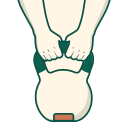
Grip strength is several abilities under one name. Crushing grip closes the hand around an object. Support grip holds a bar, bag, or suitcase. Pinch grip controls something between the fingers and thumb. Wrist and forearm strength keep those forces organized. Train the version that matches what you want to do.
Rows, deadlifts, pull-ups, and carries already build support grip. Direct grip work earns its place when your hands are the weak link, when a sport needs a specific grip, or when daily tasks have gotten harder. More isn't always better, because the fingers and elbows also absorb typing, tools, climbing, racquet sports, and other repetitive work.
What to do
- Use loaded carries or static holds once or twice per week for general support grip.
- Add controlled wrist flexion, extension, and rotation if forearm balance or a specific task matters.
- Use pinch holds for thumb and finger strength; a hand gripper doesn't train everything.
- Progress load or time, but don't make every hold a maximal test.
- Train both hands and note any meaningful side-to-side difference.
- Keep pulling exercises in the program; grip works best as part of whole-arm and upper-body strength.
For general capability, a suitcase carry is hard to beat. It works the hand, forearm, shoulder, and trunk while looking like an ordinary task. A dead hang also works, but it needs shoulders that tolerate the position. Choose handles and ranges that fit your hands; pain is not proof of effort.
A simple plan
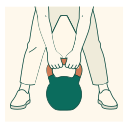
Twice per week, after your normal strength work, do two grip exercises. On day one, carry a dumbbell or kettlebell in each hand for 20 to 40 steps, rest, and repeat for three rounds. On day two, do a single-hand suitcase carry and a plate or block pinch hold for two or three rounds per side.
Start with a load you can hold without the object slipping or your posture collapsing. Add a few steps until you reach the top of the range, then add a small amount of weight. For pinch holds, start with 10 to 20 seconds. A towel or thicker handle changes the challenge, but only use it once the ordinary version is well controlled.
If the goal is pull-ups or deadlifts, do most main sets without grip aids until your hands start limiting the target muscles. Straps then let back or leg training continue while separate grip work addresses the weak link. That is a practical tradeoff, not cheating.
How to know it is working
Track a carry load and distance, a hold time on a standardized handle, or repetitions on a pulling movement before your grip fails. A hand dynamometer gives a repeatable number when used the same way each time, but it isn't required. The best measure is often the real task: opening a jar, carrying bags, holding a racquet, or hanging from a climbing hold.
Review monthly. Grip performance shifts with hand position, handle size, chalk, fatigue, temperature, and encouragement, so compare like with like. The population-level link between grip strength and health is not a promise that squeezing a gripper alone improves longevity.
If you get stuck
If your forearms are always exhausted, cut back on direct work and count the hidden grip volume from lifting, climbing, manual labor, and sports. If one hand is much weaker, train it first and give both sides the same planned work rather than doubling the weaker side right away.
Pain at the inner or outer elbow may mean too much gripping stacked on other repetitive work. Reduce the aggravating volume, vary the handle, and rebuild. Numbness, tingling, waking with hand symptoms, or dropping objects can point to a nerve problem and should not be treated as a simple strength plateau.