Overhead Press More Weight
Build a stronger overhead press with repeatable practice, balanced upper-body work, and small progressions.
 Ask Murph to help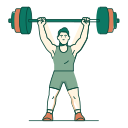
A stronger overhead press comes from practicing the press, building the shoulders and triceps, and letting small load increases add up. Tiny technique changes and big weight jumps make progress on this lift feel erratic, so use a consistent standard and the smallest practical progression.
Choose the version that fits your goal. A standing barbell press demands whole-body bracing, dumbbells let each arm find its own path, and a machine or landmine press adds stability or a more comfortable angle. They aren't interchangeable tests, but all build overhead strength.
What to do
- Press overhead twice a week: one primary session, one lighter or higher-rep session.
- Keep feet, grip, starting position, and lockout consistent enough to compare sessions.
- Train rows, pulldowns, or pull-ups too, so the shoulder girdle isn't built in one direction.
- Add triceps work, plus a little shoulder isolation if those muscles need more volume.
- Keep the torso stable; don't let a strict press drift into an unplanned standing incline press.
- Make micro-increases when you can; a standard plate jump can be a big percentage of an overhead press.
Heavy training builds maximal strength, but not every set needs to be heavy. Moderate loads give practice and muscle-building volume with less grinding. Don't test a one-rep max every week; the lift grows from productive reps, not repeated proof attempts.
A simple plan
Day one: three sets of 4 to 6 reps in your chosen press. Day two: three sets of 8 to 10 with a lighter load or dumbbells. Keep one to three good reps in reserve. Add a row or pulldown on both days and two sets of triceps work on one day.
When every primary set reaches six controlled reps, add the smallest available load and drop back to four. When every lighter set reaches ten, add a little load. Without fractional plates, add reps more gradually, use small magnetic plates, or progress a dumbbell version while the barbell load catches up.
Film one set from the side occasionally. The bar should start from a repeatable position, clear the face efficiently, and finish over a braced body. Use video to answer a specific technique question, not to judge appearance frame by frame.
How to know it is working
Track a repeatable set of three to six reps, not just a lifetime max. More reps at the same load, the same reps at a higher load, or a smoother bar path at the same effort all count. Compare the same variation; a machine number doesn't translate directly to a barbell.
Progress can be slow because the muscles involved are smaller and load jumps are proportionally large. Look at six- to eight-week trends. One bad session after hard bench pressing, poor sleep, or a demanding sport is not a plateau.
If you get stuck
If the bar leaves the shoulders but stalls near lockout, work the triceps and top-half pressing. If it never starts cleanly, more submaximal practice and shoulder strength may help. If the torso leans farther back as load rises, reduce the weight and rebuild the standard.
Check exercise order and fatigue. Heavy bench pressing the day before can flatten the overhead session, so press first on one day, separate the sessions, or cut overlapping volume. If the shoulders feel pinched, try dumbbells, a neutral grip, or a landmine angle while gradually working on comfortable overhead range.