Improve Hip Mobility
Build usable hip range for squatting, hinging, sitting, walking, and sport.
 Ask Murph to help
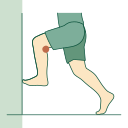
Hip mobility covers flexion, extension, rotation, and movement out to the side. No single stretch improves all of them, and there is no universal hip shape to reach. Pick the range tied to a real task: squatting deeper, extending the leg while walking, sitting cross-legged, rotating for sport, or hinging comfortably.
Hip anatomy varies. A stance that feels open and strong for one person may pinch for another. Mobility training should expand your usable options without forcing the joint through a sharp or blocked sensation.
What to do
- Pick one or two hip movements tied to your goal.
- Practice them three to five days per week in brief sessions.
- Use static stretching for a specific limited range, plus controlled strength within that range.
- Train squats, split squats, hinges, step-ups, and lateral movements as appropriate.
- Explore stance and toe angle instead of forcing a standard shape.
- Rehearse the real task after mobility work.
Stretching and resistance training can both improve range of motion. For the hips, loaded split squats, deep squats to a box, Romanian deadlifts, and controlled rotation drills can build range and strength together. A long passive routine is optional.
A simple plan
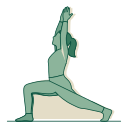
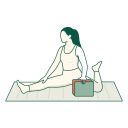
Choose two targets. For hip flexion and squat depth, do a supported deep-squat shift and a controlled split squat. For hip extension, pair a half-kneeling hip-flexor stretch with a bridge or split squat. For rotation, pair a 90/90 sitting drill with slow, controlled hip rotations.
Four days per week, do two rounds: one 30-second stretch per side, then 6 to 10 controlled repetitions of the strength or active-mobility movement. Twice per week, include a squat, hinge, and single-leg exercise in your normal strength training.
Progress by going a little farther, using less support, or adding a small load. Stop at muscular tension or effort, not a hard pinch at the front of the hip. After each session, do three repetitions of the target task.
Keep the plan narrow for the first month. Someone chasing a deeper squat may need flexion and rotation; someone trying to walk with a longer stride may need extension. Six unrelated stretches make it hard to tell which one is changing the target. Two drills and one strength movement that make a useful difference are enough. Once the first goal improves, pick another direction rather than keeping a permanent full-body mobility checklist.
Ordinary daily positions add low-intensity practice. Vary how you sit, take a few longer comfortable strides on a walk, or use the floor when it fits your life. These should feel easy; the focused sessions carry the stronger training signal.
How to know it is working
Use a repeatable movement such as squat depth, a 90/90 position, split-stance hip extension, or seated rotation. Record stance, support, and comfort. Video every two to four weeks shows whether range and control are improving.
Transfer is what counts. If a floor drill improves but the squat doesn't, add squat practice or ask whether the hip was really the limiter. More passive range only helps when it improves a meaningful movement or your comfort.
If you get stuck
If the front of the hip pinches, try a slightly wider stance, a different rotation, or less depth. Don't keep forcing through a blocked sensation. If the range is there passively but disappears during movement, build strength and balance in that position.
If one hip changed suddenly, hurts at night, catches, locks, or makes you limp, a generic mobility plan may be the wrong tool. Previous surgery, arthritis, or structural conditions can call for individualized ranges. You are after useful movement, not symmetry at any cost.