Improve My Posture
Build comfortable, adaptable positions with strength, movement variety, and a workspace that fits.
 Ask Murph to help
Good posture means positions you can hold comfortably, change before they tire you, and support with enough strength and mobility for the task. No single position is perfect for everyone. Spinal curves, shoulder position, and stance vary, and appearance alone doesn't diagnose a problem.
Start with what you actually want: less fatigue at a desk, standing taller for a presentation, an upper back that doesn't tire, or more control when lifting. That target decides whether you need workspace changes, strength, mobility, movement breaks, or all four.
What to do
- Change position often instead of holding one rigid pose all day.
- Adjust the screen, chair, keyboard, and work surface so the task comes to you.
- Strengthen the upper back, shoulders, trunk, hips, and legs two or three times a week.
- Practice the specific sitting, standing, or lifting position in short doses.
- Work on limited range only when it clearly blocks the position you want.
- Use a cue that helps, like "grow tall" or "ribs over pelvis", without bracing constantly.
Strength and endurance make a position feel easier. Rows, carries, hinges, split squats, and overhead work all help. Stretching may change range, but research doesn't support the claim that one hamstring or chest stretch permanently fixes a universal posture fault.
A simple plan
For two weeks, pick one daily context. At a desk: screen near eye level, keyboard close, feet supported, back resting against the chair. Every 45 to 90 minutes, stand, walk, or change position for two minutes.
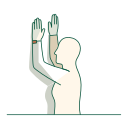
Twice a week, do two sets each of rows, a press, a hip hinge, a split squat, and a loaded carry. Three days a week, add five minutes of posture practice: five wall reaches, five upper-back rotations per side, a 20-second chest or lat stretch if you're restricted, and one minute standing relaxed and tall.
Don't force your shoulders down and back all day. Use the posture the task needs, then move. If the goal is visual, take one relaxed photo every four weeks under similar conditions instead of checking the mirror.
How to know it is working
Track comfort and endurance in your chosen context. Can you work longer before fatigue, stand through a conversation without shifting, or hold a lifting position with less thought? That matters more than matching an ideal silhouette.
Photos can show change, but lighting, angle, mood, and posing skew them. Pair any image with function and symptoms. A change that looks straighter but hurts more is not an improvement.
If you get stuck
If cues work for minutes before fatigue returns, build strength and take more breaks. If the workspace pushes your head or arms forward, change the setup. If a joint truly lacks range, use targeted mobility and strength, not a generic whole-body routine.
Persistent discomfort may not be a posture problem at all. Sleep, stress, workload, vision, and painful conditions all change how you hold yourself, so don't blame a normal body shape for every symptom. See a clinician or physical therapist when pain, weakness, or a structural condition changes the plan.