Sit Comfortably in a Deep Squat
Build the ankle, hip, balance, and squat control needed to rest comfortably near the floor.
 Ask Murph to help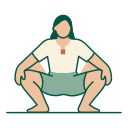
A comfortable deep squat takes ankle range, hip range, balance, and familiarity with the position. Stance width, toe angle, and body proportions change what it looks like. You're after a stable position that suits your body, not the same foot placement or perfectly upright torso as everyone else.
Use support early. Holding a door frame, counterweight, or sturdy post lets you explore depth without tipping backward. A small heel lift shows whether ankle range is a major limiter. These tools point to the next step, not to failure.
What to do
- Practice the position three to five days a week in short, relaxed exposures.
- Try a slightly wider stance and a comfortable toe angle.
- Use hand support or a light counterweight to stay balanced.
- Work on ankle dorsiflexion and hip rotation only where they actually limit the movement.
- Strengthen squats and split squats through the deepest comfortable range you control.
- Practice standing up out of the position so mobility comes with strength.
Long passive holds aren't the only route. Resistance training through full ranges improves mobility, and controlled goblet squats build range, balance, and strength together, so use a mix rather than treating the position as a pure stretching test.
A simple plan
Four days a week, hold a sturdy support and lower into a squat with the heels down if you can. Do three rounds of 20 to 30 seconds, gently shifting side to side and breathing. Use enough hand support that the position feels exploratory rather than threatening.
Then do two sets of six goblet or bodyweight squats to a box at your current depth, and two sets of eight ankle rocks per side. Twice a week, add split squats and calf raises. If the heels lift, use a thin heel wedge during the squat while you train ankle range separately.
Every two weeks, reduce hand support, lower the box, shrink the heel lift, or add ten seconds to the hold. Change one thing. Your final stance may look nothing like a barbell squat, and that's fine.
Keep resting in the position separate from lifting from it. A resting squat uses a relaxed shape you can hold for a while; a loaded squat needs bracing and control. Practice both if both matter, but don't assume a long passive hold makes a heavy squat safer. After a relaxed hold, do a few controlled rises with support so your body learns to produce force from the new depth.
If the goal is gardening, play, or floor work, rehearse reaching or shifting inside the supported squat. That transfer is what makes the range worth more than a photo.
How to know it is working
Track heel support, hand support, stance, hold time, and comfort. Progress can mean the same depth with less help, heels staying down, easier breathing, or standing up without your hands.
A monthly side photo can help, but torso angle isn't a moral score; femur length, ankle range, and stance all shape it. The outcome that counts is a position that feels stable and useful.
If you get stuck
If you tip backward, use a counterweight and train ankle range. If the hips pinch, adjust stance and toe angle or stop above the pinch. If the knees feel overloaded, use more hand support, a higher box, and progressive leg strength.
Some bony anatomy rules out certain squat shapes. A wider stance or heel lift may be the lasting answer rather than a temporary compromise. Don't force a narrow, toes-forward squat because a generic mobility standard says so.